
The Devil is in the...Sample (The Flawed Poll That Claimed Mamdani was More Popular Than Netanyahu Part 1: Funny Numbers)
Why Understanding How Organizations Design and Conduct Surveys, as well as Whom They Target with Those Surveys Matters More Than Ever (Especially In an Era When Polls Don’t Just Measure Narratives, They Manufacture Them!)


INTRODUCTION: Spin, Ill-Timed Facts, or Just More of the Same Hatred for Bibi?
(‘Emergency Propaganda’ or Sensationalized News for Click Bait?)
Over the past several hours, I kept seeing headlines touting that “American Jews” supposedly view New York City Mayor Zohran Mamdani more favorably than Israeli Prime Minister Benjamin Netanyahu. Other variations of this headline made similar claims. It struck me as odd, especially since Zohran Mamdani had just incurred the wrath of thousands of New Yorkers, including some in his base, when he urged New Yorkers to set their air conditioners to 78 degrees amid a brutal heat wave, supposedly to protect the power grid.
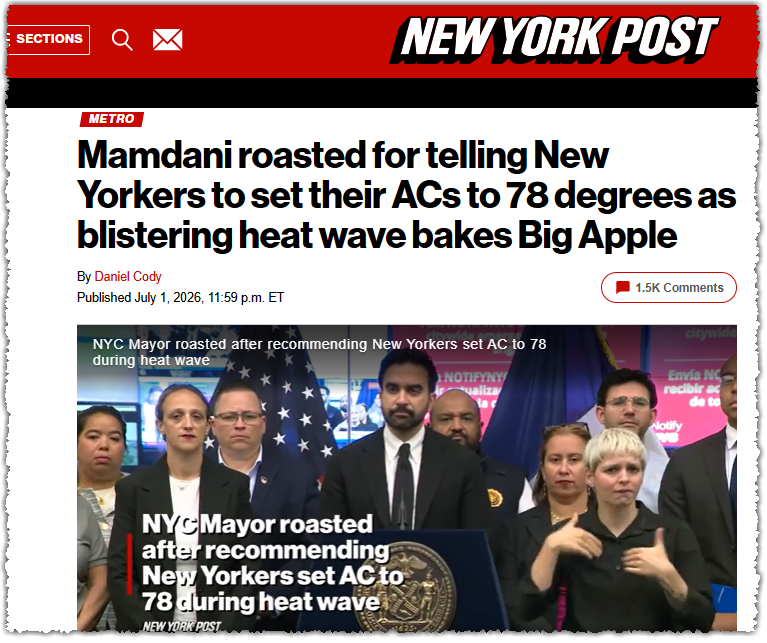
At the same time, no such guidance was issued for high-profile events like Taylor Swift and Travis Kelce’s wedding at Madison Square Garden. Around the same time, his speech marking America’s 250th anniversary, delivered right before Independence Day, was slammed across right- and center-leaning outlets as anti-American for its heavy focus on the nation’s flaws, critiques of immigration, and perceived attacks on “supremacy.” Mamdani wasn’t having a good week, and sentiment among New Yorkers only amplified this.
Then, suddenly, it is a new week, a new news cycle, a new Monday, and as if Allah himself had smiled on this fake Muslim mayor, here was a poll that reassured the world that Mamdani is popular, not hated! The poll was actually conducted back in June, but was amplified starting on July 7th through the time of this writing. These headlines, based on this AP-NORC poll, claimed “strong Jewish support” for Mamdani.
The headlines tended to misrepresent this poll as some sort of popularity contest when, in reality, it was a poll focused on issues in the Middle East and Donald Trump. This June 2026 poll actually only contained one question that mentioned Mamdani — not in the context of comparing him to Israeli Prime Minister Benjamin Netanyahu, but as a straightforward “Do you like the guy?” type of question in the context of asking about several other elected officials. In fact, Mamdani and Netanyahu weren’t even on the same page. The headlines created a narrative from a poll where Mamdani and Netanyahu were nothing more than an aside, inserted to provide context.

The main headline that circulated was from The Forward, which almost gleefully published an article titled “Mamdani more popular than Netanyahu among U.S. Jews, new poll shows.” This was followed the next day by the left-leaning, very biased “news” site Mediaite with the headline: “NEW POLL: Jewish Americans Favor Zohran Mamdani More Than Bibi Netanyahu — by a Whopping 32 Points.” Then the typical bottom-feeders followed, parroting the propaganda pioneers. The message being promoted was clear: “Mamdani is great… don’t believe your lying eyes!”
NOTE: Some of the more well-established news platforms actively pushing this particular “Mamdani Good!/Bibi Bad!” flavor of headline are The Forward (which describes itself as JEWISH. INDEPENDENT. NONPROFIT.); Mediaite (founded by Dan Abrams, former Chief Legal Analyst for ABC News and Columbia Law School graduate…yes, the same Columbia that hosted all of the anti-Israel violent protests and where Mamdani’s father is a professor); and Newsweek (mainly seen as center-left, but mostly they just follow the headlines of everyone else).
To me, this looks like what I call “Emergency Propaganda”; a leader gets in trouble politically and his loyalist news rags rush into the center ring to dazzle and distract.

I’m only speculating on motives, but the timing felt suspect. (We will look into that timing and those sources more thoroughly in the near future.) Those headlines triggered an immediate flash of anger in me, the kind of gut reaction that, from years in intelligence work, usually signals I might be getting played. I suddenly forgot about the Marxist air-conditioning public service announcement and that mousy-looking singer who married a football star, and could only grit my teeth at how stupid these people must be to like Mamdani. I was mad. And if you’re mad at something you read in a headline or on social media, then the odds are you’re being propagandized. So I stopped reading headlines and “news” and did what I always do: I went straight to the sampling data in the poll that was the source of this news nugget. That’s the best place to start when dissecting any poll for fairness and accuracy. The headlines did work — I was momentarily distracted. But not for long once I went back to my professional roots and focused on the facts, not the fiction.
The Devil is in the … Sample
The Numbers Will Lie, or at Least Manipulate You, If You Let Them.
In the world of investigative research, I’ve learned that raw data is only as good as the methods used to collect it. Polls are no exception. The June 2026 AP-NORC Center survey of 3,040 U.S. adults, featuring an oversampled group of 1,022 “Jewish adults,” grabbed headlines with claims that roughly 30% of Jewish respondents viewed Israel’s actions in Gaza as genocide, alongside strong disapproval of Benjamin Netanyahu and a surprisingly positive view of Zohran Mamdani who is viewed by many Jews as antisemitic!
As someone who’s spent years in high-level intelligence work and corporate intelligence, analyzing sources and methods as a well formed habit, these numbers demand scrutiny. Not because the poll is fabricated, but because the “who” and “how” behind the sample often drive the story more than the percentages themselves. The devil, as they say, is in the sample.
Defining “Jewish Adults”: Self-Identification and Its Limits

The AP-NORC team began with a basic religion question: “What is your present religion, if any?” Those selecting “Jewish” formed the core group. For atheists or the unaffiliated in the oversample, they asked a follow-up: “Aside from religion, do you consider yourself Jewish in any way? For example, ethnically, culturally, or because of your family background?” Only about 4% in that subgroup affirmed it.

This mirrors standard practices from Pew Research Center and others. It aims to include both observant Jews and the large secular/cultural contingent, a reasonable nod to how many American Jews see themselves.
“In theory, bad actors could falsely claim Jewish identity to push narratives on Israel.”
But self-identification is subjective and open to manipulation. Distant ancestry or loose cultural ties can qualify someone in one poll but not another. In theory, bad actors could falsely claim Jewish identity to push narratives on Israel. American Jewry is diverse — Orthodox traditionalists, Reform liberals, and everything in between — and this variability can quietly tilt results on explosive issues.
The Oversample Machine: Boosting Numbers, Then Reweighting
AP-NORC didn’t rely on the natural ~2% of respondents identifying as Jewish. They oversampled deliberately, pulling from NORC’s probability-based AmeriSpeak panel and recontacts from a prior Jewish youth survey. This yielded 1,022 Jewish interviews with its own margin of error (±5.0 points).
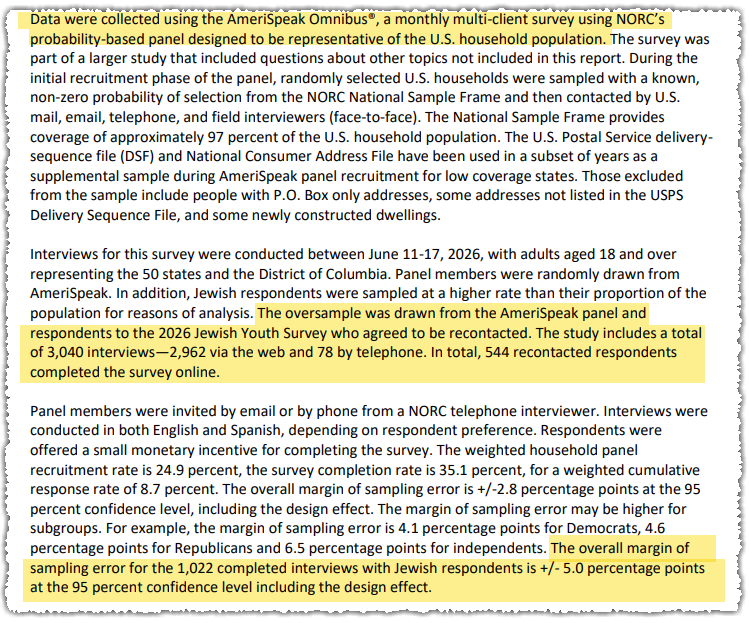
(Source: The June 2026 AP-NORC Center Poll, page 19. https://apnorc.org/wp-content/uploads/2026/07/June_Topline_mideast-1.pdf)
They then weighted the data against Census figures, Pew benchmarks, and voting records (adjusting for age, gender, education, region, race/ethnicity, and Jewish identity). It looks representative on paper. In reality, panel participants (those willing to join repeated surveys) skew more educated, engaged, and comfortable opining on divisive topics.
Explainer: Oversampling and Weighting in Plain English
Imagine you’re baking a giant cake that represents all American adults, but you only have a tiny handful of raisins (Jewish adults, who make up roughly 2% of the population). To study the raisins properly, the pollsters added a bunch more raisins on purpose…that’s oversampling. It gives them enough to analyze deeply without the whole cake being nothing but raisins. Some of those extra raisins even came from a previous “batch” (recontacts from an earlier Jewish youth survey), meaning not everyone was necessarily answering fresh questions in real time for this specific poll.
Then comes weighting: After baking, they adjust how much each piece “counts” so the final cake tastes like the real-world mix. If they accidentally grabbed too many raisins from one part of the pantry (say, younger, liberal ones who like surveys), they dial their influence down and boost others to match Census data, Pew studies, and voting records. It aims for balance, but if the extra raisins you added were mostly from the same shelf, or carried over from an earlier survey, the adjustments can only do so much. The result looks representative on paper, but the flavor might still lean toward whoever showed up most eagerly (or agreed to be recontacted).
Demographics Tell Their Own Story
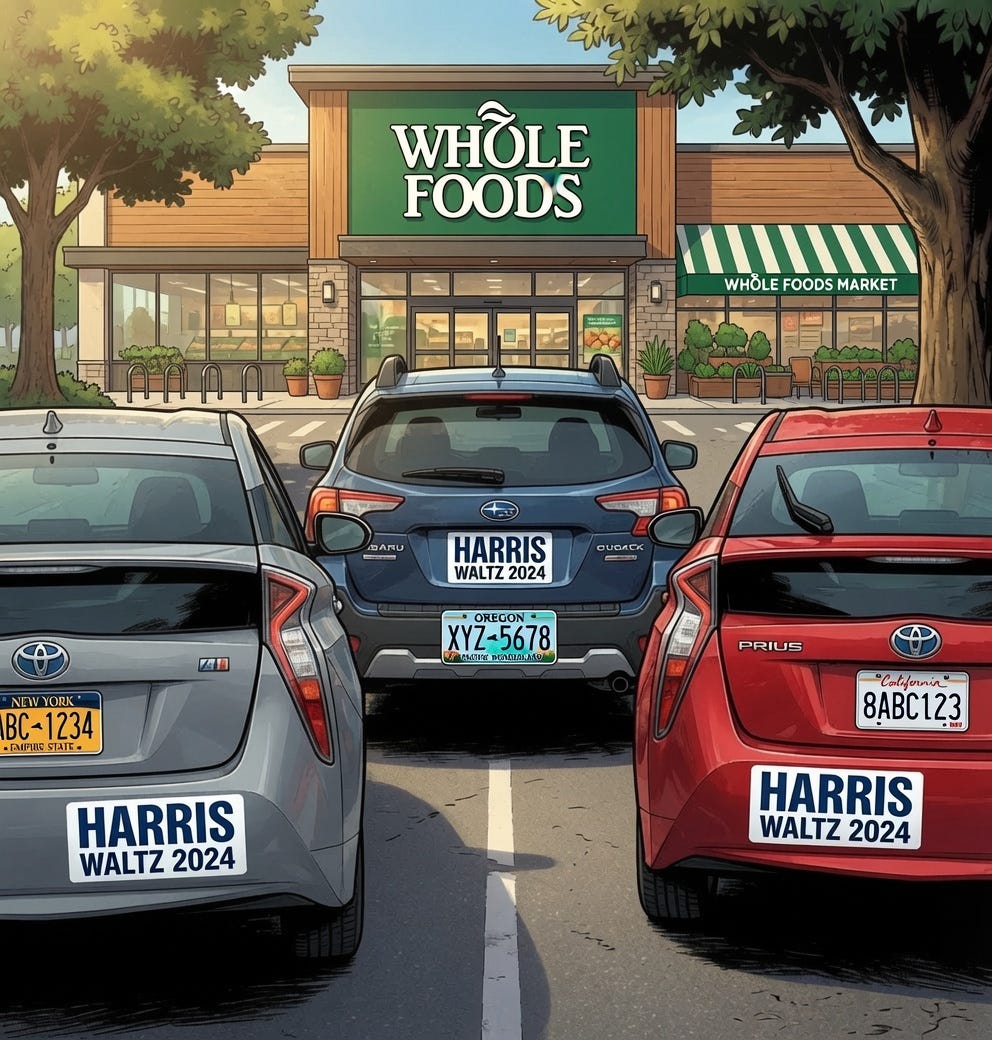
The weighted Jewish sample is older (36% 60+, vs. 28% overall), well-educated (55% with bachelor’s or higher), and predominantly White non-Hispanic (87%). But the standout feature is the heavy leftward tilt: 59% Democrat net, 42% liberal net, and 53% reporting a 2024 vote for Kamala Harris.
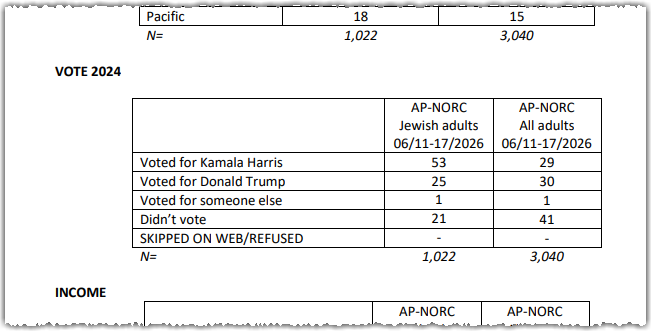
(Source: The June 2026 AP-NORC Center Poll, page 18. https://apnorc.org/wp-content/uploads/2026/07/June_Topline_mideast-1.pdf)
This isn’t surprising given broader Jewish demographic trends toward urban, educated, left-leaning profiles. Yet it matters. This subsample closely mirrors the broader pool of Democrats, left-leaners, and Harris voters in other polling on Gaza, Netanyahu, and progressive Israel critics — groups that routinely register higher criticism of Israeli actions and more openness to challengers of traditional pro-Israel positions. The AP-NORC results track that pattern closely, raising questions about how well they capture the full diversity of American Jewish opinion.
A Hypothetical Flip: What If the Sample Looked Different?

Flip the partisan numbers for illustration (a purely hypothetical estimation inverting the reported splits): Imagine the Jewish subsample showed 59% Republican net, 42% conservative net, and 53% voting for Donald Trump in 2024. The outcomes would likely reverse — far fewer genocide accusations, firmer backing for Netanyahu, and cooler reception for figures like Mamdani. Headlines might celebrate Jewish solidarity with Israel or conservative foreign policy alignment. The “Jewish view” would appear transformed. This exercise shows the poll captures a genuine left-leaning slice of Jewish America well — but risks overstating its representativeness.
Skepticism Is a Feature, Not a Bug
This doesn’t mean the poll is useless. Probability-based frames like AmeriSpeak plus careful weighting are among the stronger tools available. Oversampling small groups is standard and practical.
Still, rigorous skepticism is required. Question wording, oversampling choices, identity definitions, and panel tendencies can influence outcomes. On charged topics like genocide claims or U.S. policy, selection and response biases intensify. Strong opinions motivate participation; weighting helps but isn’t flawless. The risk of misrepresentation adds another layer.
This isn’t conspiracy thinking, it’s how complex societies are measured. Intelligence professionals live by evaluating sources and methods. Apply the same standard here: Examine who answered, how they were chosen, and what adjustments were made before accepting any poll as the definitive “Jewish view.”
In today’s fragmented media landscape, surveys don’t merely reflect opinion, they help shape it. Scrutinizing the sample isn’t nitpicking; it’s essential. Next time a provocative poll drops, pause and ask: Who exactly was in the room, and why does that matter? The real story often hides in the details of how the data was gathered.
So let’s do a little better next time, AP-NORC, because now you have our attention — and for all the wrong reasons.